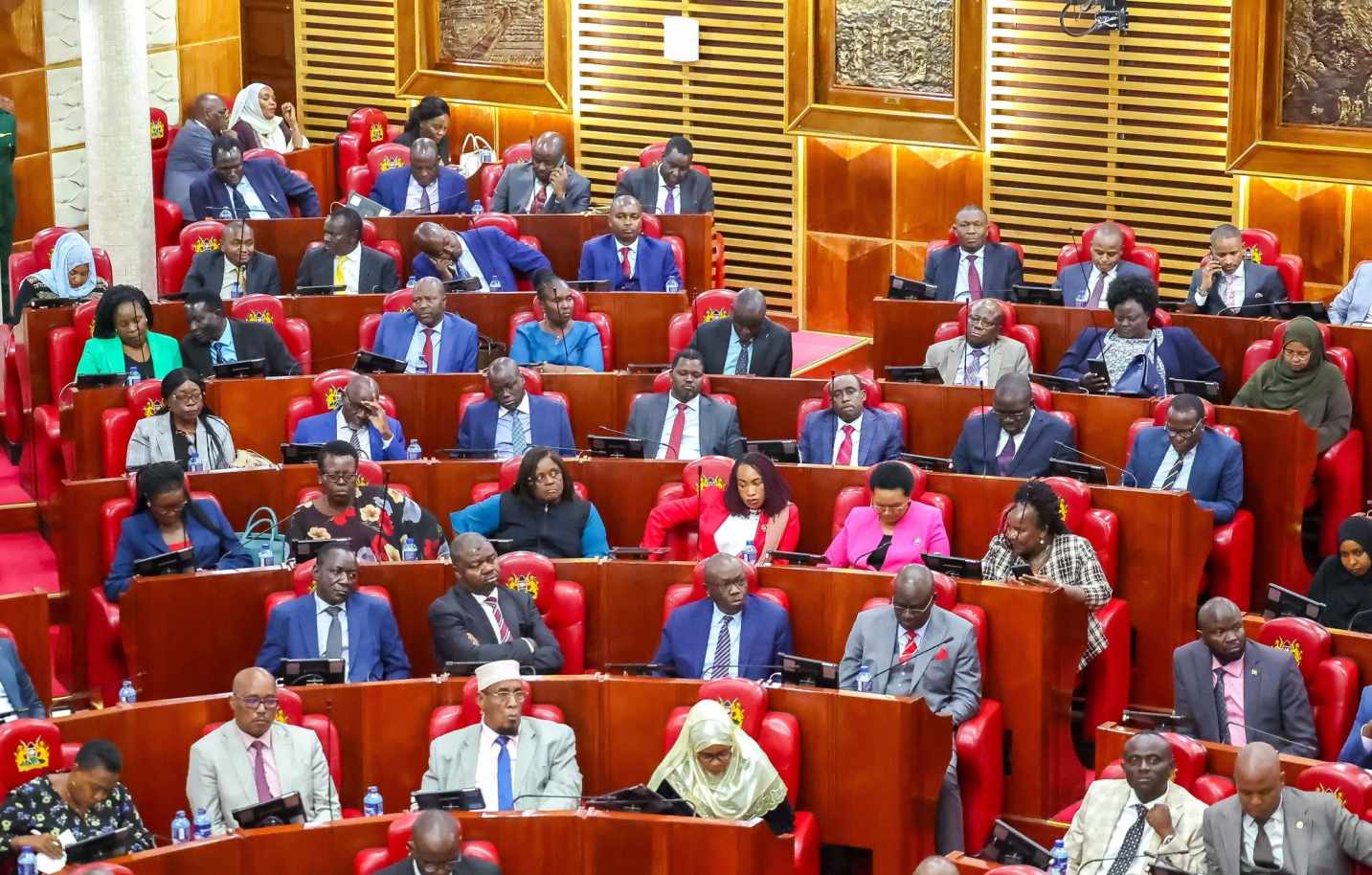
The National Assembly has ordered urgent intervention to steady the rollout of the Competency-Based Education system after lawmakers warned that poor planning, uneven funding and weak oversight risk derailing the transition of the pioneer Grade 9 learners into Senior school.
The directive followed heated discussions at a legislative retreat in Naivasha, where Members of Parliament said many schools remain ill-prepared for Grade 10 due to delayed capitation, unequal infrastructure development and rising pressure on parents, exposing deep cracks in the implementation of CBE.
Education Cabinet Secretary Julius Ogamba, who briefed legislators on the transition, conceded that infrastructure support had not been evenly distributed across regions but maintained that corrective measures were underway.
He said the ministry is working under tight timelines to build 1,600 laboratories in 1,452 schools by June to support the hands-on learning model under the new curriculum.
Lawmakers questioned how the Education Infrastructure Fund was being applied, saying there was little clarity on which schools were benefiting and why some regions appeared excluded.
“In the Northern Frontier, it’s NG-CDF that is entirely funding school infrastructure. You said 1,600 laboratories are benefitting from the Infrastructure Fund, publish that list on your website,” Mandera North MP Bashir Abdullahi demanded.
“We are seeing a clear deficit in marginalised areas. What will the ministry do to correct this imbalance?” Kilifi North MP Owen Baya asked.
Ogamba reported that over 98 per cent of learners had already transitioned to Senior school, adding that teams were still tracking down the remaining learners to meet the government’s goal of full transition. MPs, however, said the figures masked serious challenges facing schools and families.
Several legislators said parents were being forced to buy uniforms from selected vendors at inflated prices, turning public education into a costly burden and undermining government policy.
National Assembly Majority Leader Kimani Ichung’wah said uniform purchases and lunch charges had become breeding grounds for corruption, blaming inspectors for failing to act.
“The CS has the power to gazette school fees. The ministry must gazette the amount to be charged on school feeding programmes and how much parents should pay for school uniforms,” Ichung’wah said, warning that education should not be turned into a political issue.
“Why are we forcing teachers to change uniforms to feed the corruption cartels distributing uniforms?” he asked, calling on Basic Education PS Julius Bitok to personally inspect schools.
Ichung’wah also faulted the Teachers Service Commission over staff deployment, saying poor rationalisation had left some schools with surplus teachers while others struggled with shortages.
“TSC is not doing the right thing on rationalisation. Why should we have a school with 1,000 teachers and a neighbouring school with less than 100 teachers?” he asked.
He said teachers posted to schools facing closure due to low enrolment should be reassigned to institutions with staffing gaps to maintain learning standards.
Speaker Moses Wetang’ula said government rules clearly bar schools from sending learners home over fees or uniforms, but noted that weak enforcement at local levels was undermining the policy.
“You can have a policy in Nairobi, but do we have officers on the ground implementing it?” he asked.
Ogamba further alarmed lawmakers by revealing that the ministry does not have accurate data on the real cost of educating a learner from primary school to university. He said the current capitation figures of Sh1,420 for primary school, Sh15,042 for Junior school and Sh22,244 for Senior school were outdated and no longer reflected reality.
He added that the existence of county bursaries, NG-CDF support and community fundraising had complicated efforts to determine actual education costs, calling for a fresh review to harmonise support.
Describing the issues as serious, Wetang’ula directed House leadership and the Education Committee to urgently meet and develop solutions to safeguard learning across the country.
“I challenge you, CS Migos, to establish guidelines for consolidating duplicated education bursaries into a single central basket for efficient distribution to the intended beneficiaries,” the Speaker said.
Concerns have also extended to tertiary institutions. The Public Investments Committee on Governance and Education raised red flags over governance failures, financial mismanagement and inclusivity gaps in several Technical and Vocational Education and Training institutions.
While acknowledging progress in some colleges, the committee cited Auditor General reports highlighting unresolved land ownership disputes, lack of ethnic balance in recruitment and millions of shillings in unutilised HELB loans and bursaries. In one institution, Sh22 million remained unused after funds were released late to students who had already paid their fees.
The committee ordered that the funds be refunded to allow other learners to benefit and called for audits to ensure future allocations are properly managed.
Religious leaders have also joined the debate. Speaking on Sunday at Nyeri Catholic Cathedral, Archbishop Anthony Muheria described the Senior school transition as “chaotic and erratic”, saying learning had stalled in some schools weeks after reporting on January 12.
“We are robbing the future of these same children while in Grade 7 stayed for a year without learning and now in Grade 10 and still not learning,” he said.
Muheria criticised the handling of Kenya Sign Language in the 2025 KCSE examination, saying its exclusion from mean grade calculations for some candidates was “a scar” on the education system despite the subject being examined.
“These three issues are really a scar because we have not had the courage to face the problematic systemic presentation of the CBE. CBE can be a very good education system but it seems we have not thought it through and we are always knee-jerking, one person making declaration and another one making another,” he said.
He also raised concerns over placement disparities, saying some C1 schools were overwhelmed with up to 2,000 Grade 10 learners while others recorded very low numbers.
“We have students who have been taken to the national schools with 45 points and others with great points of 60 and above been placed to some of the other poorer schools. This is a lack of justice.”
Muheria warned that unless the imbalances are addressed, the system risks deepening inequality between schools.
Ogamba has previously said schools that receive no or very few Grade 10 learners may be merged or closed to allow better use of teachers and resources. Schools without Grade 10 classes will stop operating as learning centres once the final 8-4-4 cohort completes Form Four at the end of 2027.































Comments
Sign in with Google to comment, reply, and like comments.
Continue with Google